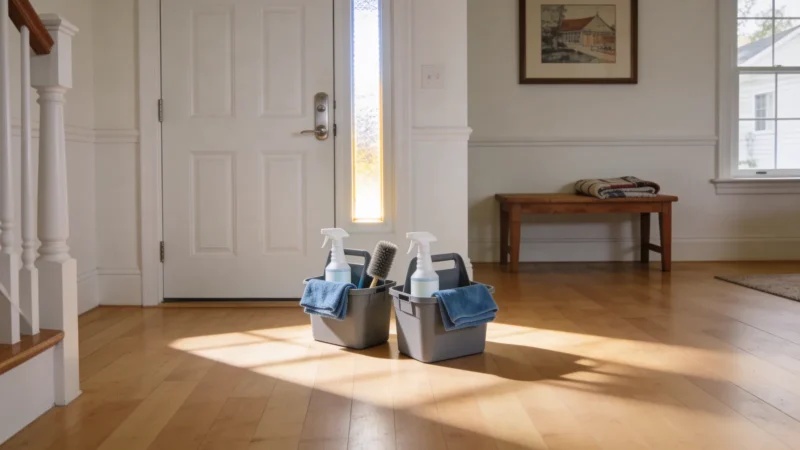
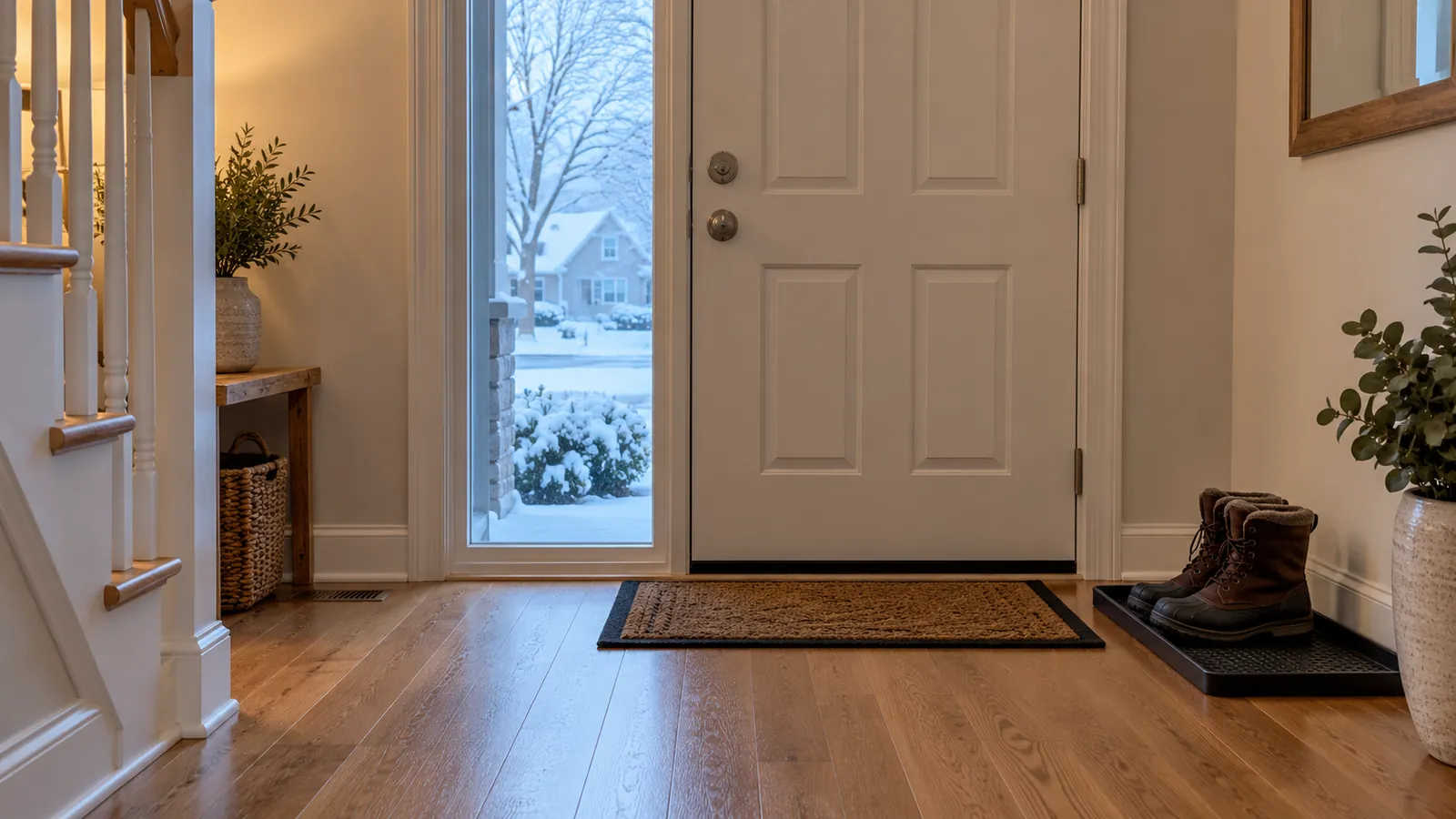
Road salt does most of its damage in the first few feet inside the door. The crystals scratch hardwood and vinyl, and the residue dries into a white film that a regular mop just spreads around. Two mats, a boot tray and a dry pass every evening keep most of it out. A weekly damp clean with a floor-safe cleaner takes care of the rest.
Why is road salt so hard on floors?
Because it does two kinds of damage at once: the crystals scratch, and the dissolved salt leaves a film that dulls the finish. Both happen right inside the doors you use most, usually the front entry, the garage door and the mudroom.
From the first snow in late fall until mud season in March, the roads, driveways and sidewalks around Columbus stay coated with salt and ice melt. Every pair of boots carries some of it in. On hardwood and luxury vinyl, the grit gets ground into the finish under foot traffic. On tile, the film collects in the grout lines. On carpet near the door, salty water wicks into the fibers and dries into a stiff, white crust.
None of it shows up all at once. It’s the reason an entry floor that looked fine in December looks dull and hazy by the end of February.
What’s the simplest routine that works?
Stop the salt at the door, then pick up whatever gets past it before it dries. Ten minutes a day is enough.
| Where | What | How often |
|---|---|---|
| Outside the door | A coarse bristle mat that scrapes grit off soles | Shake it out weekly |
| Just inside | An absorbent mat long enough for two full steps | Shake out and vacuum both sides weekly |
| Next to the mat | A boot tray, so wet boots don’t sit on the floor | Empty and rinse when it fills |
| Entry floor | A dry microfiber pass or a vacuum with the beater bar off | Every evening |
| Entry floor | A damp mop with a cleaner made for your floor type | Once a week |
The dry pass matters more than it looks. Mopping a floor that still has grit on it drags the crystals across the finish. Pick up the dry grit first, then clean the film.
How do you get white salt residue off floors?
With a barely damp mop and a pH-neutral cleaner made for your floor, after the grit is gone. Use as little water as you can, and dry the floor when you’re done.
A few things to avoid on hardwood and luxury vinyl:
- Soaking the floor. Standing water and salt together get into the seams between boards.
- Strong all-purpose cleaners. They can dull a wood finish faster than the salt does.
- Steam mops on wood. Heat and moisture are hard on the finish and the seams.
- Letting it wait for the weekend. Film that sits for days is harder to lift than film that sits overnight.
If you’re not sure what your floor’s finish can take, the manufacturer’s care instructions are the safest guide. Test any new cleaner on a spot that doesn’t show, like inside a closet.
What should you ask your cleaners to change in the winter?
Ask for the entry floors to be done last, with a clean mop head, and for the mats to be cleaned on both sides. Those two changes keep the salt from being carried through the rest of the house.
A few other winter requests worth making:
- Clean the baseboards on both sides of the entry, where salty water splashes and dries.
- Wipe the boot tray and the floor under it.
- Do the stair treads closest to the door, which collect grit from people heading upstairs in socks.
- Tell them what your floor is: hardwood, luxury vinyl, tile or laminate. Each takes a different cleaner.
If you’re on a recurring plan, mention it once at the start of the season and ask for it to stay on your list until spring. Having the same two cleaning professionals every visit helps here: they’ll know which door gets the traffic.
When does salt season end?
Usually in March, when the last snow melts and mud season starts. That’s also the right time for a deep clean that catches up on the baseboards, entry walls and floors after a winter of boots.
The estimator gives you a range for a deep clean or a recurring plan in about a minute.