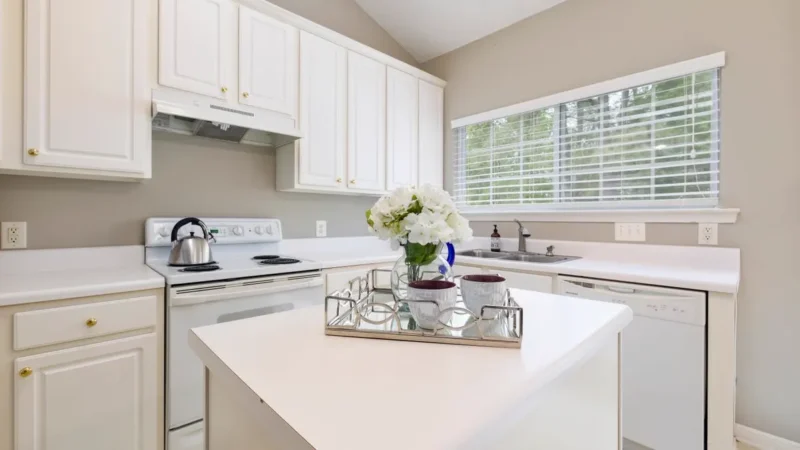
The 80/20 rule of house cleaning says that a small share of your home, roughly 20 percent, makes about 80 percent of the mess people actually notice. Keep those few spots clean every day, the kitchen counters and sink, the entry floor, the main bathroom sink and the living room surfaces, and the whole house looks cared for, even between real cleanings.
Where does the 80/20 rule come from?
It’s borrowed from the Pareto principle, the old rule of thumb that most results come from a small share of causes. Applied to a home, it means you don’t need to clean everything every day; you need to clean the right few things.
The numbers aren’t a measurement. Nobody has weighed the dust. They’re a way of saying that the mess isn’t spread evenly: it piles up where people drop things, cook, wash and walk in from outside. Clean those places and you’ve dealt with most of what anyone sees.
Which parts of the house are the 20 percent?
The surfaces everyone sees and touches every day. In most homes it comes down to five spots:
| Spot | Why it matters | The daily version |
|---|---|---|
| Kitchen counters and sink | First thing people see, and where crumbs and dishes collect | Clear the counter, wipe it, empty the sink |
| Entry floor | Every shoe crosses it; dirt spreads from here to every room | A dry sweep or a quick vacuum |
| Main bathroom sink and mirror | Toothpaste, water spots and hair show fast | A wipe with a cloth after the morning routine |
| Living room surfaces | Coffee table and couch are where the day lands | Put things back, fold the throw, clear the table |
| The “drop zone” | The counter or chair where mail, bags and keys end up | Empty it once a day |
Notice what isn’t on the list: baseboards, vent covers, ceiling fans, the inside of the fridge. They matter, but they build up slowly and nobody notices them day to day. That’s the work regular professional cleanings are for.
What’s a good ten-minute daily routine?
Do the five spots in the same order every evening, and stop at ten minutes. A short routine you keep beats a long one you skip.
- Kitchen, three minutes. Load the dishwasher, wipe the counters, rinse the sink.
- Living room, two minutes. Put back what’s out of place and clear the coffee table.
- Drop zone, one minute. Mail in one place, bags on hooks, keys in a bowl.
- Bathroom, two minutes. Wipe the sink and the mirror, hang the towels.
- Entry, two minutes. Sweep or vacuum the floor inside the door. In the winter, this is the step that keeps road salt from spreading; salt season has more on that.
How does the 80/20 rule work with professional cleaning?
The daily routine keeps the visible 20 percent under control, and professional visits take care of the other 80 percent: the floors in every room, the bathrooms top to bottom, the dusting and the details that build up slowly.
Together, they change what each visit has to do. A house where the counters, sink and entry are kept up between visits needs less catch-up work every time, which keeps visits shorter and the house closer to how it looked the day it was cleaned. That’s also why the right frequency depends on your household: how often should you have your house cleaned? walks through how to choose.
For a three-bedroom, two-and-a-half-bath house in average condition, recurring cleaning every two weeks runs $115 to $150 per visit, and monthly $135 to $175.
What if the house is already past the 80/20 point?
Then the daily routine can’t catch it up on its own, and a deep clean resets it first. Ten minutes a day keeps a clean house clean; it doesn’t undo months of buildup on baseboards, shower glass and cabinet fronts.
The usual order is a deep clean, then regular visits with the daily routine in between. The estimator shows the range for both on your own home in about a minute.